
5.9 KiB
Cliparser
The old style with mixed custom commandline parsing of user parameters or options was messy and confusing. You can find all kinds in the Proxmark3 client. Samples
data xxxx h
script run x.lua -h
hf 14a raw -h
hf 14b raw -ss
lf search 1
lf config h H
In order to counter this and unify it, there was discussion over at the official repository a few years ago (link to issue) and there it became clear a change is needed. Among the different solutions suggested @merlokk's idea of using the lib cliparser was agreed upon. The lib was adapted and implemented for commands like
emv
hf fido
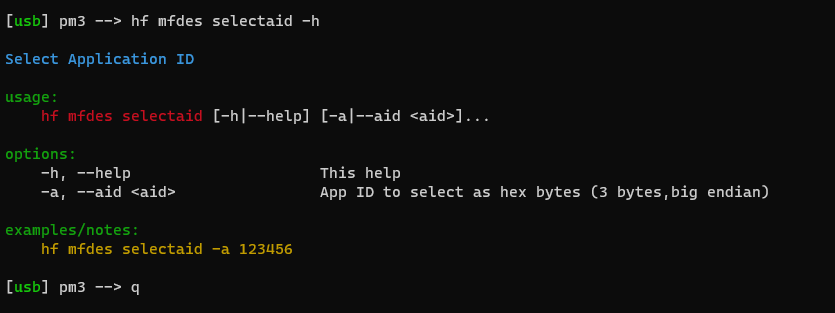
And then it fell into silence since it wasn't well documented how to use the cliparser. Looking at source code wasn't very efficient. However the need of a better cli parsing was still there. Fast forward today, where more commands has used the cliparser but it still wasn't the natural way when adding a new client command to the Proxmark3 client. After more discussions among @doegox, @iceman1001 and @mrwalker the concept became more clear on how to use the cliparser lib in the preferred way. The aftermath was a design and layout specfied which lead to a simpler implemtentation of the cliparser in the client source code while still unfiy all helptexts with the new colours support and a defined layout. As seen below, the simplicity and clearness.
cliparser setup and use
The parser will format and color and layout as needed.
It will also add the -h --help option automatic.
design comments
- where possiable all options should be lowercase.
- extended options preceeded with -- should be short
- options provided directly (without an option identifier) should be avoided.
- -vv for extra verbos should be avoided; use of debug level is prefered.
- with --options the equal is not needed (will work with and without) so dont use '='
e.g. cmd --cn 12345
common options
-h --help       : help
--cn            : card number
--fn            : facility number
--q5            : target is lf q5 card
--raw           : raw data
-k --key        : key supplied
-n --keyno      : key number to use
-v --verbose    : flag when output should provide more information, not conidered debug.
-1 --buffer     : use the sample buffer
How to implement in source code
setup the parser data structure
Header file to include
#include "cliparser.h"
In the command function, setup the context
CLIParserContext *ctx;
define the text
CLIParserInit (<context>, <description>, <notes\n examples ... >);
use -> to seperate example and example comment and \n to seperate examples. e.g. lf indala clone -r a0000000a0002021 -> this uses .....
CLIParserInit(&ctx, "lf indala clone",
              "clone INDALA UID to T55x7 or Q5/T5555 tag",
              "lf indala clone --heden 888\n"
              "lf indala clone --fc 123 --cn 1337\n"
              "lf indala clone -r a0000000a0002021\n"
              "lf indala clone -l -r 80000001b23523a6c2e31eba3cbee4afb3c6ad1fcf649393928c14e5");
define the options
void *argtable[] = {
    arg_param_begin,
    arg_lit0("l", "long", "optional - long UID 224 bits"),
    arg_int0("c", "heden", "<decimal>", "Cardnumber for Heden 2L format"),
    arg_strx0("r", "raw", "<hex>", "raw bytes"),
    arg_lit0("q", "Q5", "optional - specify writing to Q5/T5555 tag"),
    arg_int0(NULL, "fc", "<decimal>", "Facility Code (26 bit format)"),
    arg_int0(NULL, "cn", "<decimal>", "Cardnumber (26 bit format)"),
    arg_param_end
};
All options has a parameter index, since -h --help is added automatic, it will be assigned index 0.
Hence all options you add will start at index 1 and upwards.
Notes:
booleen : arg_lit0 ("<short option>", "<long option>", ["<format>",] <"description">)
integer
optional integer : arg_int0 ("<short option>", "<long option>", ["<format>",] <"description">)
required integer : arg_int1 ("<short option>", "<long option>", ["<format>",] <"description">)
Strings 0 or 1
optional string : arg_str0("<short option>", "<long option>", ["<format>",] <"description">)
required string : arg_str1("<short option>", "<long option>", ["<format>",] <"description">)
Strings x to 250
optional string : arg_strx0 ("<short option>", "<long option>", ["<format>",] <"description">)
required string : arg_strx1 ("<short option>", "<long option>", ["<format>",] <"description">)
if an option does not have a short or long option, use NULL in its place
show the menu
CLIExecWithReturn(<context>, <command line to parse>, <arg/opt table>, <return on error>);
CLIExecWithReturn(ctx, Cmd, argtable, false);
clean up
Once you have extracted the options, cleanup the context.
CLIParserFree(ctx);
retreiving options
bool option
arg_get_lit(<context>, <opt index>);
is_long_uid = arg_get_lit(ctx, 1);
int option
arg_get_int_def(<context>, <opt index>, <default value>);
cardnumber = arg_get_int_def(ctx, 2, -1);
hex option
CLIGetHexWithReturn(<context>, <opt index>, <store variable>, <ptr to stored length>);
?? as an array of uint_8 ??
uint8_t aid[2] = {0};
int aidlen;
CLIGetHexWithReturn(ctx, 2, aid, &aidlen);
hex option returning ???
uint8_t key[24] = {0};
int keylen = 0;
int res_klen = CLIParamHexToBuf(arg_get_str(ctx, 3), key, 24, &keylen);
quick test : seems res_keylen == 0 when ok so not key len ???
string option
CLIGetStrWithReturn(<context>,<opt index>, <unsigned char *>, <int *>);
uint8_t Buffer[100];
int BufLen;
CLIGetStrWithReturn(ctx,7, Buffer, &BufLen);